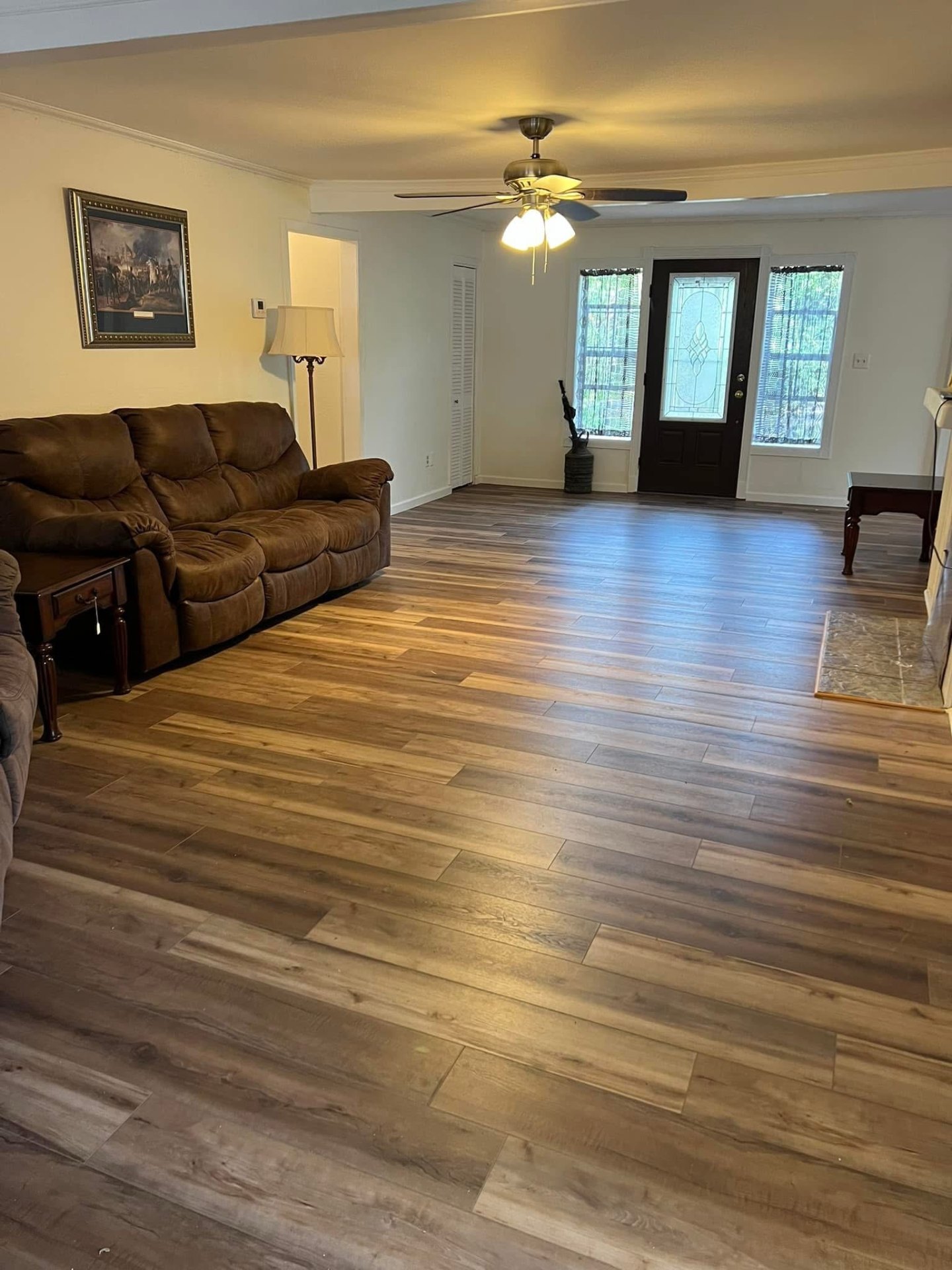
Luxury vinyl plank is the single most popular flooring choice on the Gulf Coast right now — and it's not hard to see why. It's 100% waterproof, handles pets and kids without scratching, and the high-end stuff looks so much like real hardwood that you genuinley have to get on your knees and touch it to tell the difference. But 'luxury' in the name makes people assume it's expensive. It's not — at least not compared to the hardwood it's replacing. Here's exactly what LVP flooring costs in the Pensacola area in 2026, with no filler and no national averages that don't apply to our market.
LVP Material Costs Per Square Foot in 2026
LVP material costs in Pensacola range from $2 to $7 per square foot. The variation comes down to three things: core type, wear layer thickness, and brand.
Budget LVP ($2-3/sq ft material) — Entry-level vinyl plank with WPC (wood polymer composite) or thin SPC core, 12-20 mil wear layer, and basic wood-grain printing. This tier works for rental properties, guest rooms, and areas where you need waterproof flooring on a tight budget. The thinner wear layer means more susceptibility to scratching from pets and furniture, and the visual realism isn't as convincing as mid-range products. But it's still 100% waterproof, which already puts it ahead of carpet and laminate in practical terms.
Mid-range LVP ($3-5/sq ft material) — This is where most Pensacola homeowners land and where the value is hardest to beat. SPC (stone polymer composite) rigid core provides excellent stability and dent resistance. 20-28 mil wear layer handles heavy residential traffic including pets. Embossed-in-register (EIR) texturing aligns the surface feel with the printed grain — this is what makes modern LVP look genuinely like hardwood. Brands like COREtec, Mohawk SolidTech, and Shaw Floorté fall in this range. For whole-house installations in the Gulf Coast, mid-range SPC is the sweet spot.
Premium LVP ($5-7/sq ft material) — Top-tier vinyl plank with 28-40 mil commercial-grade wear layer, extra-thick rigid SPC core, and the most realistic visuals available. Some premium products include attached underlayment, reducing installation cost. LifeProof, COREtec Plus, and Mohawk UltraWood are examples. Premium LVP is built to last 25+ years in heavy traffic and is warrantied for light commercial use. For Pensacola homeowners who want the durability to last through decades of Gulf Coast living, this tier delivers.
WPC vs SPC Core — What's the Difference and How It Affects Cost
You'll see these two abbreviations constantly when shopping for LVP. Understanding the diffrence saves money and prevents regrets.
WPC (Wood Polymer Composite) — The original 'luxury' vinyl plank core. WPC is softer and more cushioned underfoot, with a slightly thicker profile (typically 6-8mm). It's quieter to walk on and more comfortable for standing. WPC costs about $0.50-1.00 less per square foot than SPC in the same brand line. The trade-off: WPC dents more easily from heavy furniture and chair legs, and its softer core can telegraph subfloor imperfections. WPC works well in bedrooms, home offices, and areas with lighter traffic.
SPC (Stone Polymer Composite) — The newer, denser core technology. SPC is rigid and dense (contains limestone powder), making it virtually immune to denting, temperature changes, and subfloor imperfections. SPC is thinner (typically 4-6mm) but harder underfoot — some people find it less comfortable for extended standing without shoes. SPC costs slightly more but it's the dominant technology for good reason: it's more dimensionally stable in Gulf Coast heat, handles heavy furniture without denting, and installs over slightly imperfect subfloors without showing problems through the surface.
For Pensacola homes, we generally recommmend SPC for main living areas, kitchens, and high-traffic zones. WPC is a good choice for bedrooms and home offices where comfort matters more than impact resistance. Either way, both are 100% waterproof — the core type doesn't affect moisture performance.
LVP Installation Labor Costs in Pensacola
Professional LVP installation labor in the Pensacola area runs $1.50-3.00 per square foot. LVP installs faster than tile or hardwood but takes similar time to laminate.
Basic floating installation ($1.50-2.00/sq ft labor) — Click-lock LVP over clean, flat subfloor with existing or pre-attached underlayment. Includes furniture moving and basic cleanup. A standard bedroom installs in half a day.
Full-service installation ($2.00-3.00/sq ft labor) — Includes old flooring removal, subfloor preparation (leveling, cleaning, moisture testing on concrete), underlayment installation, LVP installation with proper expansion gaps, transition strips between rooms, quarter-round or baseboard work, and thorough cleanup. This is what most homeowners need.
Underlayment ($0.25-0.75/sq ft) — If your LVP doesn't have attached underlayment, a separate foam or cork pad goes down first. On Florida concrete slabs, a vapor barrier underlayment is essential — moisture from the slab can cause mold under the LVP even though the plank itself is waterproof. The moisture doesn't damage the vinyl — it creates problems in the trapped space between the slab and the flooring.
Glue-down LVP ($2.50-3.50/sq ft labor) — Some premium LVP products use glue-down installation for maximum stability and the most solid underfoot feel. This costs more in labor but eliminates any hollow sound or plank movement. Commercial LVP installations typically use glue-down.
A key advantage of LVP: most rooms install in one day. A whole-house LVP project (1,200-1,500 sq ft) typically takes 2-3 days including furniture moving and old flooring removal. Compare that to tile (5-10 days) or hardwood (3-5 days plus acclimation). The faster installation means lower total labor cost.
Total LVP Cost — Real Pensacola Project Examples
Here's what complete LVP projects cost in the Pensacola and Gulf Coast market in 2026, all-in with materials, underlayment, and professional installation:
Single room (150 sq ft) — Budget: $675-900
Budget WPC LVP ($3/sq ft) + underlayment ($0.50/sq ft) + installation ($1.50/sq ft) = approximately $5/sq ft total. A bathroom or bedroom done in a few hours.
Single room (150 sq ft) — Mid-range: $975-1,350
Mid-range SPC LVP ($4/sq ft) + underlayment ($0.50/sq ft) + full-service installation ($2/sq ft) = approximately $6.50/sq ft total. Includes old flooring removal, subfloor prep, and transitions.
Whole house (1,200 sq ft) — Budget: $5,400-7,200
Budget LVP throughout all living areas, bedrooms, and hallways. Whole-house pricing typically reduces per-square-foot cost since mobilization and setup happen once.
Whole house (1,200 sq ft) — Mid-range: $7,800-10,800
Mid-range SPC throughout. This is the most common LVP project we do in Pensacola — homeowners replacing old carpet or worn flooring throughout with one continuous waterproof surface.
Whole house (1,200 sq ft) — Premium: $9,600-14,400
Premium SPC with attached underlayment and commercial-grade wear layer. Maximum durability and visual realism for homeowners who want the floor to last 25+ years without showing wear.
These prices are specific to the Pensacola and Gulf Coast market. See our full pricing guide or call (850) 903-3703 for your free in-home estimate.
How LVP Costs Compare to Other Flooring
LVP sits in the middle of the flooring cost spectrum — more expensive than carpet and laminate, but cheaper than hardwood and most tile.
LVP vs carpet: LVP $4-8/sq ft vs carpet $2-5/sq ft installed. LVP costs more upfront but lasts 15-25 years versus carpet's 10-15. LVP is waterproof, easier to clean, and better for allergy sufferers. Carpet is softer and warmer. Many Pensacola homeowners use LVP throughout the main house and carpet in bedrooms — best of both worlds.
LVP vs laminate: LVP $4-8/sq ft vs laminate $3-6/sq ft installed. Similar price range, but LVP is 100% waterproof while laminate is NOT waterproof. For any room that sees moisture — kitchens, bathrooms, laundry rooms, entryways — LVP's waterproof construction makes the $1-2/sq ft premium well worth it. For dry bedrooms and offices, laminate saves a little money with compareable performance.
LVP vs hardwood: LVP $4-8/sq ft vs hardwood $8-15/sq ft installed. Hardwood costs 2x+ more, requires humidity control in Florida, and isn't waterproof. LVP is waterproof, dimensionally stable, and virtually maintenance-free. Hardwood can be refinished (LVP can't) and adds more resale value. For most Gulf Coast homeowners who want the wood look without the wood hassles, LVP delivers at half the price.
LVP vs tile: LVP $4-8/sq ft vs tile $5-12/sq ft installed. Both are waterproof. Tile lasts longer (50-100+ years vs 15-25). LVP is warmer underfoot, faster to install, and softer to stand on. For bathrooms and showers, tile is still the better choice (LVP shouldn't go in showers). For kitchens and living areas, LVP offers comparable performance at a lower price with more comfort.
What Drives LVP Cost Up or Down
Several factors affect your final LVP price beyond the per-square-foot material cost.
Wear layer thickness is the biggest quality differentiator. 12 mil is builder-grade (scratches easily, 10-15 year life). 20 mil is standard residential (handles pets, 15-20 years). 28 mil is premium residential (heavy traffic, 20-25 years). 40 mil is commercial-grade (maximum durability, 25+ years). Every step up in wear layer adds $0.50-1.00 per square foot. For homes with dogs, we recommend minimum 20 mil — their nails will scratch through 12 mil within a year.
SPC costs more than WPC — typically $0.50-1.00 per square foot more. But SPC's rigidity, density, and temperature stability make it the better value for Gulf Coast installations where heat and humidity test flooring materials constantly.
Plank width and length affect price. Standard 6-inch wide planks are the most affordable. Wide plank (7-9 inches) costs $0.50-1.50 more per square foot but creates a more modern, spacious look. Extra-long planks (48-72 inches) also command a premium.
Subfloor condition matters. LVP is more forgiving than tile or hardwood, but significant unevenness still needs correction. Leveling compound adds $1-3/sq ft. On concrete slabs — common in Pensacola construction — moisture testing and vapor barrier underlayment add $0.50-1.00/sq ft but prevent problems that would void your warranty.
Pattern and layout. Standard stagger installation is fastest and most affordable. Herringbone LVP is growing in popularity but costs 15-20% more in both materials (more waste from cuts) and labor. Diagonal layouts add 10% to material costs.
Where to Save on LVP Without Sacrificing Quality
Smart savings come from knowing where quality matters and where it doesn't.
Don't overpay for wear layer you don't need. A guest bedroom used twice a year doesn't need 28 mil commercial-grade wear layer. 20 mil handles it perfectly at $1-2 less per square foot. Save the thicker wear layer for the kitchen, hallway, and family room where daily traffic actually tests it.
Choose standard plank widths. Unless wide plank is critical to your design, standard 6-inch planks cost $0.50-1.50 less per square foot and look great. Wide plank creates a more modern aesthetic, but standard width is the better value for larger projects.
LVP with attached underlayment saves money. Products with pre-attached cork or foam backing eliminate the seperate underlayment purchase ($0.25-0.75/sq ft savings) and reduce installation time. Most mid-range and premium SPC products now include attached underlayment.
Buy the same product for the whole house. Running one consistent LVP product throughout all rooms is cheaper than mixing products — you get volume pricing, less waste from partial boxes, and no transition strips between rooms with matching flooring.
Get your free in-home estimate first. Day Flooring comes to you with our mobile showroom — see LVP samples in your own lighting, get honest advice about which products match your lifestyle and budget, and receive a transparent per-square-foot quote. No showroom markup, no pressure. Call (850) 903-3703.
Frequently Asked Questions
LVP flooring in Pensacola costs $4-8 per square foot fully installed, including materials ($2-7/sq ft), underlayment ($0.25-0.75/sq ft), and professional installation labor ($1.50-3.00/sq ft). Mid-range SPC vinyl plank at $6-7/sq ft total is the most popular choice for Gulf Coast homeowners.
Yes — LVP provides the best value of any flooring type for most Pensacola homes. It's 100% waterproof (critical for Gulf Coast humidity), handles pets and heavy traffic, looks remarkably like real hardwood, and costs 40-60% less than actual hardwood installed. The 15-25 year lifespan with virtually zero maintenance makes the per-year cost extremely competitive.
Budget WPC vinyl plank starts at $2-3 per square foot for materials, with total installed cost around $4-5/sq ft. This is still 100% waterproof and significantly more durable than carpet or laminate. For rental properties and low-traffic rooms, budget LVP provides excellent value.
SPC (Stone Polymer Composite) is better for most applications — it's denser, more rigid, resists denting from heavy furniture, and handles Gulf Coast temperature swings without expanding. WPC (Wood Polymer Composite) is softer and more comfortable underfoot, making it better for bedrooms. SPC costs about $0.50-1.00 more per square foot than equivalent WPC.
Whole-house LVP installation (1,200 sq ft typical Pensacola home) costs $5,400-14,400 depending on product quality. Budget: $5,400-7,200. Mid-range: $7,800-10,800. Premium: $9,600-14,400. Includes materials, underlayment, old flooring removal, subfloor prep, installation, transitions, and cleanup. Most whole-house LVP projects complete in 2-3 days.