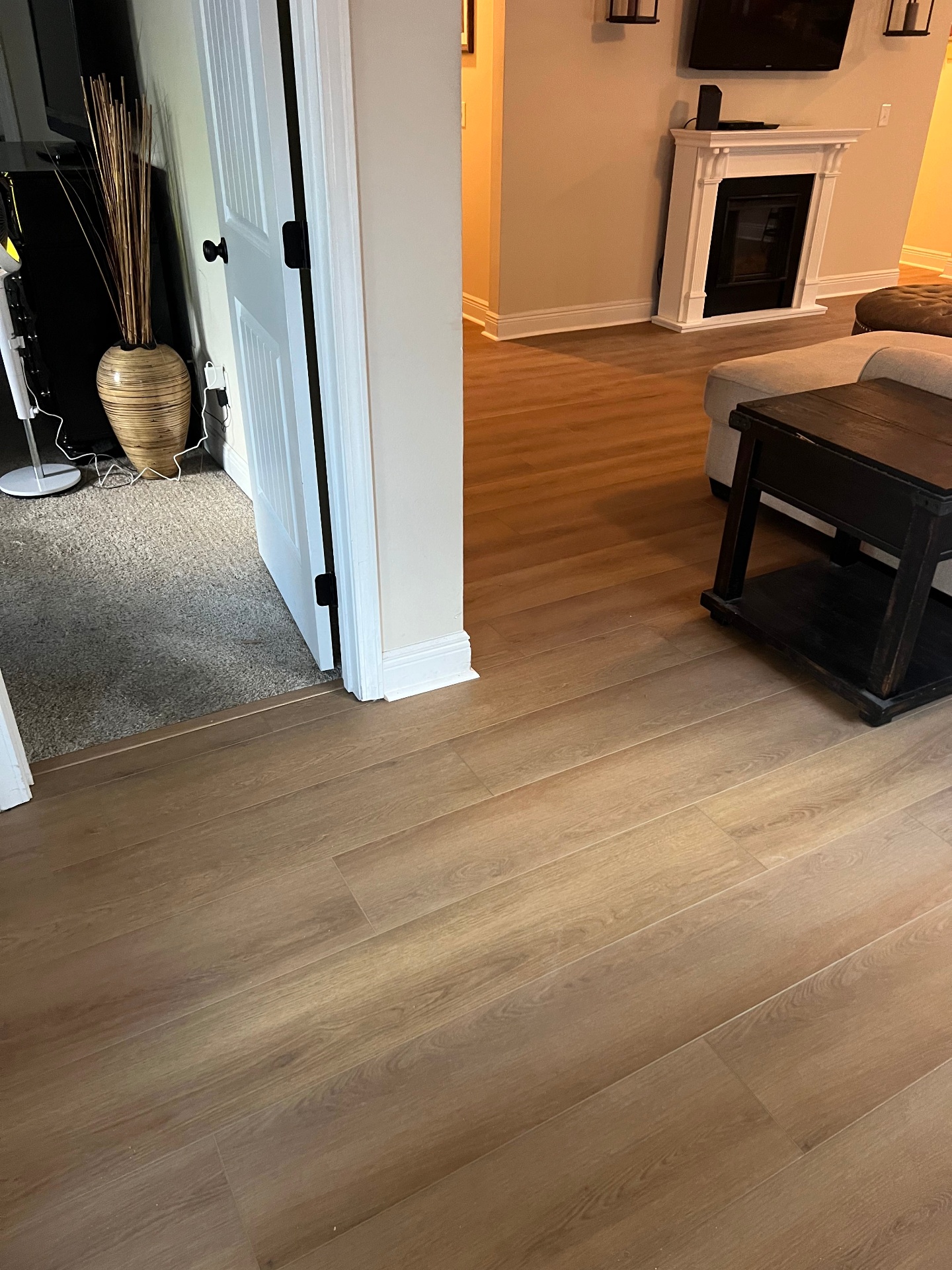

Tools and Preparation
LVP installation requires minimal tools, many of which you may already own. Having everything ready before starting ensures smooth, efficient installation.
Essential Tools
- Tape measure: For measuring room and planks
- Pencil: Marking cut lines
- Speed square: Ensuring straight, perpendicular cuts
- Utility knife: Scoring planks for snap cuts
- Straight edge: Guiding utility knife for long cuts
- Pull bar: Essential for installing last rows near walls
- Rubber mallet: Gently tapping planks together (with tapping block)
- Tapping block: Protects plank edges when joining
- Spacers: Maintaining 1/4" expansion gap
- Safety glasses: Eye protection during cutting
- Knee pads: Comfort for floor work
Optional But Helpful
- Jigsaw: For complex cuts around obstacles
- Oscillating multi-tool: Undercutting door jambs
- Miter saw or circular saw: Faster cuts on thicker SPC products
- Chalk line: Planning layout in large rooms
Materials Checklist
- LVP flooring: Calculate square footage plus 10% for cuts and waste
- Underlayment: If not pre-attached to planks
- Transition strips: For doorways and meeting other flooring types
- Quarter round or shoe molding: To cover expansion gaps at walls
Subfloor Preparation
Proper subfloor preparation is critical for LVP success. While LVP is more forgiving than some flooring types, subfloor issues will telegraph through and can cause problems over time.
Subfloor Requirements
LVP requires a subfloor that is:
- Clean: Free from dust, debris, and residue
- Dry: Moisture levels within acceptable range
- Flat: Variations no greater than 3/16" over 10 feet
- Smooth: No bumps, ridges, or debris that will show through
Acceptable Subfloors
LVP can be installed over:
- Concrete: If dry, flat, and free from moisture issues
- Plywood: Must be smooth with no raised edges or loose areas
- Existing vinyl: If well-adhered and flat
- Existing tile: If grout lines are filled and surface is flat
- Existing hardwood: If flat and stable
DO NOT Install Over
- Carpet or carpet padding
- Loose or peeling flooring
- Severely uneven surfaces
Addressing Common Issues
- High spots: Sand or grind down to level
- Low spots: Fill with floor leveling compound
- Deep grout lines: Apply self-leveling compound or skim coat
- Squeaky plywood: Secure with screws before installing LVP
Moisture Testing
Especially important in Florida's humid climate:
- Test concrete with moisture meter or calcium chloride test
- Verify basement and slab moisture levels are acceptable
- Use moisture barrier underlayment over concrete if recommended
Planning Your Layout
Taking time to plan before installing ensures an attractive, professional result. Poor planning leads to narrow cuts at walls, awkward patterns, and more waste.
Acclimation
Store LVP in the installation room for 24-48 hours before installing. This allows planks to adjust to room temperature and humidity, reducing expansion or contraction after installation. Open boxes but keep planks stacked flat.
Direction of Installation
LVP typically looks best when planks run:
- Parallel to the longest wall in the room
- Toward the main light source (perpendicular to windows often works well)
- Lengthwise down hallways and corridors
- Continuous through connected rooms for visual flow
Calculating First and Last Row Width
Avoid ending with narrow strips at walls:
- Measure room width perpendicular to plank direction
- Divide by plank width to determine number of rows
- If the last row would be less than 2-3 inches, rip the first row narrower
- Aim for balanced widths at starting and ending walls
Stagger Pattern
End joints should be staggered for strength and appearance:
- Minimum 6" offset between end joints in adjacent rows
- Random stagger looks more natural than systematic patterns
- Use cut-off pieces from previous rows to start new rows (if 6"+ long)
- Mix planks from multiple boxes to randomize color variation
Dry Layout
Before committing, dry-fit the first few rows without clicking together:
- Verify your starting point results in acceptable end cuts
- Identify any obstacles requiring special cuts
- Confirm you won't end with awkward narrow strips
Step-by-Step Installation
With preparation complete, you're ready to install. LVP's click-lock system makes the actual installation straightforward.
Step 1: Install Underlayment (If Needed)
If your LVP doesn't have pre-attached underlayment:
- Roll out underlayment perpendicular to plank direction
- Butt edges together (don't overlap unless manufacturer specifies)
- Tape seams with underlayment tape
- Install only as much as you'll cover that day
Step 2: Install First Row
- Place spacers along starting wall (1/4" from wall)
- Lay first plank with tongue facing the wall
- Connect end joints of subsequent planks by angling and clicking
- Cut final plank in row to length, leaving 1/4" expansion gap
Step 3: Continue Row by Row
- Start second row with cut-off from first row (if 6"+ long) for automatic stagger
- Angle long edge into previous row's groove
- Press down to click into place
- Engage end joint before fully clicking long edge
- Use tapping block if needed to fully engage joints
- Maintain spacers along walls
Step 4: Work Across the Room
- Continue installing row by row, always checking alignment
- Verify joints are fully engaged by running hand over seams
- Clean as you go—don't trap debris under planks
- Work toward exit to avoid stepping on fresh installation
Step 5: Install Final Row
- Measure width needed (accounting for 1/4" expansion gap)
- Mark and cut planks to width using utility knife and straight edge
- Use pull bar to engage final row—tapping block won't fit
- Ensure joints fully click despite limited access
Step 6: Finish the Installation
- Remove all spacers
- Install transition strips at doorways
- Install baseboards or quarter round to cover expansion gaps
- Attach trim to wall, not floor (floor must float)
Cutting LVP Planks
One of LVP's advantages is easy cutting. Most cuts require only a utility knife, though power tools speed up the process.
Score-and-Snap Method (Most Common)
For straight cross-cuts and lengthwise rips:
- Measure and mark cut line on plank face
- Align straight edge with mark
- Score deeply with utility knife, making 2-3 passes
- Bend plank along score line—it snaps cleanly
- Finish by cutting through backing if needed
This method works for most WPC and SPC products. Very thick or rigid SPC may require a saw.
Power Saw Cutting
For thick SPC products or faster cutting:
- Miter saw: Fast, precise cross-cuts
- Circular saw: Works for cross-cuts and rips with guide
- Table saw: Efficient for multiple rip cuts
Use fine-tooth blade (80+ teeth for miter/circular). Cut face-up for clean edge on the visible surface.
Complex Cuts
For cutting around obstacles:
- Jigsaw: Curves and notches around pipes, door frames, corners
- Oscillating multi-tool: Plunge cuts and undercutting door jambs
- Hole saw: Round cuts for pipes
Undercutting Door Jambs
For a clean look, undercut door frames so LVP slides underneath:
- Place plank (on underlayment) next to jamb as a height guide
- Mark jamb at top of plank
- Cut jamb with oscillating multi-tool or hand saw
- Slide plank under cut jamb during installation
Troubleshooting Common Issues
Even well-planned installations encounter challenges. Here's how to address common LVP installation issues.
Planks Won't Click Together
- Debris in joint: Clean groove and tongue of sawdust
- Alignment issue: Ensure plank is properly positioned before clicking
- Damaged locking mechanism: Discard damaged planks
- Angle issue: Some systems require specific insertion angle
Gaps Appearing Between Planks
- Joints not fully engaged: Use tapping block to close
- Subfloor unevenness: May need to address subfloor issues
- Temperature changes: Normal minor movement; excessive gaps indicate installation issues
Planks Lifting at Edges (Peaking)
- Insufficient expansion gap: Verify 1/4" gap exists at all walls
- Pinch points: Check for moldings, door frames, or furniture pinning the floor
- Transition strip issues: Ensure transitions allow floor movement
Floor Feels Bouncy or Hollow
- Subfloor issues: Low spots or uneven areas beneath
- Missing underlayment: Underlayment adds cushion and stability
- Normal for floating floors: Some hollow feeling is normal; excessive bouncing indicates problems
Visible Pattern Repetition
- Mix planks from multiple boxes during installation
- Avoid placing identical planks next to each other
- Check plank patterns before clicking in place
For professional LVP installation with warranty protection, contact our Pensacola team. Learn more about LVP flooring characteristics or browse our vinyl flooring collection.