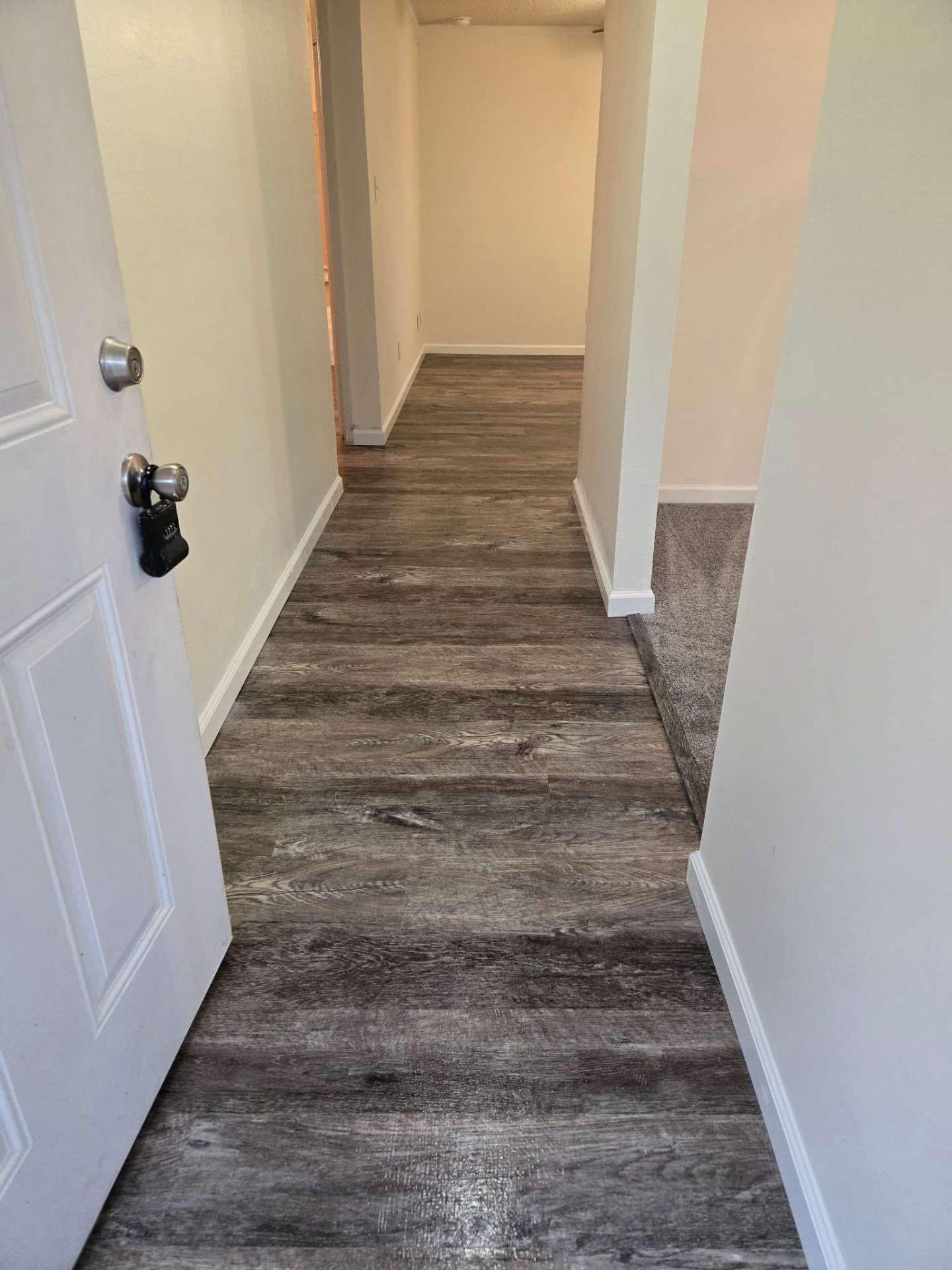

Understanding the Construction Differences
The fundamental difference between laminate and vinyl lies in their core materials—and this difference drives most of their performance variations.
Laminate Flooring Construction
Laminate flooring is built in four layers:
- Wear Layer: Clear melamine resin that protects against scratches, fading, and stains
- Design Layer: High-resolution photographic image of wood, stone, or tile
- Core Layer: High-density fiberboard (HDF) made from compressed wood fibers—this is laminate's vulnerability point, as wood fibers absorb water
- Backing Layer: Melamine backing for moisture resistance and stability
Laminate is essentially a photograph of wood protected by a hard plastic surface, sitting on a wood-based core. The core's composition makes laminate vulnerable to water damage.
Vinyl Flooring Construction
Modern luxury vinyl plank (LVP) is built with:
- Wear Layer: Clear urethane or ceramic-bead coating (measured in mils) that protects against scratches and stains
- Design Layer: High-resolution photographic image, often with embossed-in-register texturing
- Core Layer: Either SPC (stone plastic composite—rigid and dense) or WPC (wood plastic composite—slightly softer with better sound absorption)
- Backing Layer: Often includes attached cork or foam underlayment
Vinyl is 100% synthetic—no wood fibers anywhere. This makes it completely waterproof from top to bottom.
Why This Matters
Laminate's wood-fiber core means water exposure causes swelling and permanent damage. Vinyl's synthetic construction means water causes no damage whatsoever. This single difference determines where each flooring type can and cannot be installed.
Water Resistance: The Critical Difference
Winner: Vinyl (by a wide margin)
Water resistance is the most significant performance difference between laminate and vinyl—and the primary reason vinyl has gained market share in recent years.
Vinyl: 100% Waterproof
Vinyl flooring is completely impervious to water:
- Standing water on the surface causes no damage (though you should still clean it up)
- Spills that seep between planks don't damage the core
- High humidity causes no swelling or warping
- Pet accidents, drink spills, and wet feet are non-issues
- Can be installed in bathrooms, kitchens, basements, laundry rooms—anywhere in the home
Laminate: Water-Vulnerable
Laminate's HDF core is its Achilles heel:
- Standing water seeps into seams and is absorbed by the wood-fiber core
- Absorbed water causes irreversible swelling—the floor buckles and the damage is permanent
- Even "water-resistant" laminate only delays damage; prolonged exposure still causes failure
- Spills must be wiped up immediately
- High humidity (above 60%) can cause edge swelling over time
- Not recommended for bathrooms, laundry rooms, or basements
What "Water-Resistant" Laminate Actually Means
Some manufacturers offer "water-resistant" or "waterproof" laminate with treated cores and sealed edges. These products handle splashes and quick cleanup better than traditional laminate, but:
- They're still not truly waterproof—the core is still wood-based
- Standing water will eventually penetrate
- We don't recommend them for wet areas where vinyl works perfectly
Bottom line: If the room will ever get wet, choose vinyl.
Durability and Lifespan Comparison
Both flooring types are durable, but they resist different types of damage differently.
Scratch Resistance
- Laminate: Very good scratch resistance due to hard melamine wear layer. The AC rating (AC3-AC5) indicates durability—AC4 or AC5 handles heavy residential and light commercial traffic.
- Vinyl: Good scratch resistance, measured by wear layer thickness (6-28 mil). Thicker wear layers (20+ mil) resist scratches well. SPC cores dent less than WPC.
For scratch resistance specifically, quality laminate often edges ahead of vinyl—the melamine surface is harder than urethane.
Dent Resistance
- Laminate: Excellent dent resistance. The hard HDF core doesn't compress under furniture or high heels.
- Vinyl: Good but not perfect. Heavy furniture can dent vinyl over time (use furniture pads). WPC cores dent more easily than SPC.
Impact Resistance
- Laminate: Can chip or crack from sharp impacts. Dropped dishes or tools may cause permanent damage.
- Vinyl: More forgiving of impacts due to slight flexibility. Drops are less likely to cause visible damage.
Expected Lifespan
| Quality Level | Laminate | Vinyl (LVP) |
|---|---|---|
| Budget | 8-12 years | 10-15 years |
| Mid-range | 12-18 years | 15-20 years |
| Premium | 18-25 years | 20-25+ years |
Pet and Family Considerations
For homes with pets and active families:
- Vinyl handles pet accidents without damage (waterproof)
- Both resist pet nail scratches reasonably well
- Vinyl's softer feel is more comfortable for pets
- Spilled drinks and wet boots are no problem on vinyl
For pet owners, vinyl is the safer choice overall.
Comfort and Feel Underfoot
How flooring feels when you walk on it matters, especially in rooms where you stand for extended periods.
Temperature
- Laminate: Feels cool to the touch, similar to wood. Conducts temperature from the subfloor.
- Vinyl: Warmer and more temperature-neutral. Attached underlayment provides insulation. Better for basements and concrete subfloors.
Cushioning
- Laminate: Hard and rigid. Requires separate underlayment for cushioning. Can feel tiring during long standing.
- Vinyl: Slightly softer, especially WPC products. Attached underlayment adds cushioning. More comfortable for extended standing in kitchens.
Sound
- Laminate: Can sound hollow or "clicky" when walked on, especially with thin underlayment. Transmits sound to rooms below.
- Vinyl: Quieter, especially WPC cores and products with attached underlayment. Better sound absorption.
Authenticity of Feel
- Laminate: Feels harder and more plastic-like than real wood
- Vinyl: Also doesn't feel like real wood, but the slight give is often perceived as more natural
Neither feels like real hardwood, but both look increasingly realistic.
Cost Comparison
Both laminate and vinyl are budget-friendly compared to hardwood or tile, but price ranges overlap significantly.
Material Costs
| Quality Level | Laminate | Vinyl (LVP) |
|---|---|---|
| Budget | $0.75-1.50/sq ft | $1.50-2.50/sq ft |
| Mid-range | $1.50-3.00/sq ft | $2.50-4.50/sq ft |
| Premium | $3.00-5.00/sq ft | $4.50-7.00/sq ft |
Installation Costs
Professional installation adds $2-4/sq ft for either material. Both are DIY-friendly, making self-installation a significant cost saver.
Additional Costs
- Underlayment: Laminate requires separate underlayment ($0.25-0.75/sq ft). Many vinyl products include attached underlayment.
- Moisture barriers: Both may need moisture barriers over concrete—vinyl's waterproof nature provides more protection if barriers fail.
- Transitions and trim: Similar costs for both ($3-8 per linear foot)
Total Installed Cost Example (1,000 sq ft)
| Scenario | Laminate | Vinyl (LVP) |
|---|---|---|
| Budget DIY | $1,000-1,750 | $1,750-2,750 |
| Mid-range Professional | $3,500-5,000 | $4,500-6,500 |
| Premium Professional | $5,000-7,000 | $6,500-9,000 |
Long-Term Value
While laminate costs less upfront, consider:
- Vinyl lasts longer on average
- Vinyl won't be destroyed by water incidents
- Vinyl can be installed everywhere; laminate may require different flooring in wet areas
For whole-house installations, vinyl's versatility often provides better overall value despite higher initial cost.
Installation Comparison
Both laminate and vinyl feature click-lock systems that make DIY installation accessible, but there are important differences.
Ease of Installation
- Laminate: Straightforward click-lock installation. Planks are rigid and easy to handle. Cutting requires a saw (miter saw or circular saw works well).
- Vinyl: Very easy click-lock installation. Planks can be cut with a utility knife (score and snap) for most cuts, making the process quieter and generating less dust. Slightly heavier than laminate.
Vinyl is generally considered easier, primarily because cutting with a utility knife is simpler than using power saws.
Subfloor Requirements
- Both: Require clean, dry, flat subfloors (within 3/16" over 10 feet)
- Laminate: More sensitive to subfloor imperfections; bumps telegraph through
- Vinyl: More forgiving of minor imperfections, especially products with thicker cores
Underlayment
- Laminate: Requires separate underlayment—foam, cork, or combination products. Adds a step and cost.
- Vinyl: Many products include attached underlayment. When underlayment is attached, installation is faster.
Acclimation
- Laminate: Must acclimate 48-72 hours in the room before installation. Sensitive to humidity changes.
- Vinyl: Less sensitive to acclimation—24-48 hours typically sufficient. SPC cores are particularly stable.
Installation Locations
- Laminate: Above-grade, dry areas only. Not for bathrooms, laundry rooms, or basements.
- Vinyl: Any room in the home, including bathrooms, basements, and over concrete.
Appearance and Style Options
Both laminate and vinyl offer extensive style options, with modern products achieving remarkable realism.
Visual Realism
- Laminate: High-resolution printing produces realistic wood and stone images. Quality varies significantly by brand and price point.
- Vinyl: Also uses high-resolution printing. Premium products feature embossed-in-register (EIR) texturing where the texture aligns with the printed grain, enhancing realism significantly.
Modern luxury vinyl often looks more realistic due to superior texturing technology.
Style Variety
Both offer extensive options:
- Wood looks (oak, hickory, walnut, maple, exotic species)
- Stone and tile looks (marble, slate, travertine, concrete)
- Various plank widths (narrow to wide plank)
- Multiple colors from light naturals to dark espresso
- Different textures (smooth, hand-scraped, wire-brushed, distressed)
Pattern Variation
- Laminate: Pattern repetition can be noticeable in large rooms. Better products have 8-10+ different plank designs.
- Vinyl: Similar pattern repetition concerns. Premium products offer more variation.
Long-Term Appearance
- Laminate: Maintains appearance well but can show wear patterns in high-traffic areas. Cannot be refinished.
- Vinyl: Also maintains appearance well. Thicker wear layers resist visible wear longer. Cannot be refinished.
Our Room-by-Room Recommendations
Based on each material's strengths and limitations, here's where each makes the most sense.
Choose Vinyl (LVP) For:
- Kitchens: Water exposure from sinks, dishwashers, and spills makes vinyl the clear choice
- Bathrooms: Only waterproof flooring should be used in bathrooms
- Laundry rooms: Washing machine leaks and flooding risk demand waterproof flooring
- Basements: Moisture concerns, flooding risk, and concrete subfloors favor vinyl
- Entryways and mudrooms: Wet shoes and tracked-in moisture require waterproof protection
- Whole-house installations: One flooring that works everywhere simplifies design and eliminates transitions between different materials
- Homes with pets: Accidents happen; vinyl handles them without damage
- Families with young children: Spills and messes are inevitable; vinyl shrugs them off
Consider Laminate For:
- Bedrooms: Low moisture risk makes laminate's cost advantage relevant
- Home offices: Dry environments where scratch resistance matters
- Living rooms: If no moisture concerns and budget is tight
- Upper floors: Dry areas away from water sources
- Tight budgets: When cost savings outweigh waterproof benefits in dry areas
Our Overall Recommendation
For most homeowners, luxury vinyl plank (LVP) is the better overall choice:
- The waterproof advantage eliminates worry about spills and moisture
- It works in every room, simplifying whole-home installations
- It's more forgiving of DIY installation mistakes
- It's more comfortable underfoot
- Long-term value often exceeds the higher initial cost
Laminate remains a good choice for budget-conscious buyers installing only in dry areas where its water vulnerability won't be tested.
Browse our vinyl plank collection or laminate options, or contact us for a free consultation.