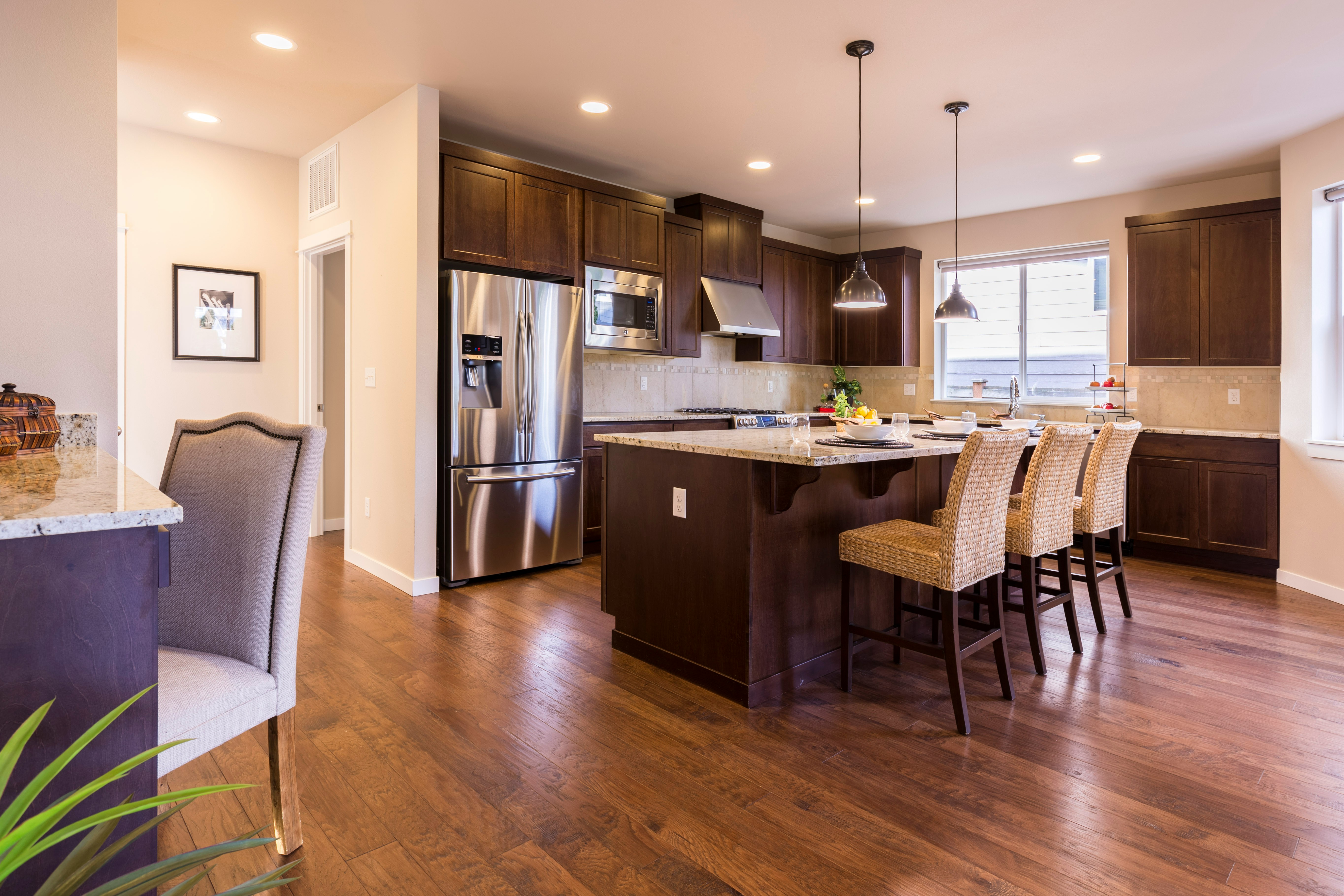

Pros and Cons of Kitchen Hardwood
Before diving into species selection and protection strategies, let's honestly assess whether hardwood makes sense for your kitchen. The answer depends on your lifestyle, maintenance commitment, and priorities.
Advantages of Kitchen Hardwood
- Visual continuity: Hardwood flowing from living areas into the kitchen creates seamless design that makes spaces feel larger and more cohesive. This open-concept aesthetic is highly valued in modern homes.
- Timeless beauty: Unlike flooring trends that date quickly, hardwood remains perpetually stylish. Kitchens with quality hardwood floors consistently photograph well and appeal to home buyers.
- Home value: Real hardwood adds measurable value to homes. In competitive real estate markets, hardwood floors—even in kitchens—command premiums over synthetic alternatives.
- Refinishing potential: Unlike any other flooring material, hardwood can be sanded and refinished multiple times over its lifetime. Even kitchen floors damaged by years of wear can be restored to like-new condition.
- Comfort: Wood is warmer and softer underfoot than tile, reducing fatigue during extended cooking sessions. This comfort factor matters in rooms where you stand frequently.
- Acoustic properties: Hardwood absorbs sound better than tile, creating quieter kitchen environments—a subtle but appreciated benefit.
Challenges and Risks
- Water vulnerability: This is the primary concern. Standing water from sink splashes, dishwasher leaks, refrigerator ice maker failures, or forgotten spills can damage hardwood permanently. Water causes warping, cupping, and finish failure.
- Scratch potential: Dropped utensils, pet nails, chair legs, and grit tracked in from outside all scratch hardwood surfaces. Kitchens see more of this abuse than other rooms.
- Maintenance demands: Kitchen hardwood requires more vigilant care than hardwood in other rooms. Spills must be addressed immediately, not "later."
- Higher cost: Quality hardwood suitable for kitchen use costs more than alternatives like LVP, especially when factoring in premium finishes and professional installation.
- Humidity sensitivity: Florida's humidity can stress hardwood floors, causing expansion in summer and contraction in winter. Kitchens add moisture from cooking and dishwashing.
- Catastrophic failure risk: A major water event (burst pipe, flooding, extended leak) can destroy hardwood floors entirely, requiring complete replacement.
The bottom line: Kitchen hardwood can succeed beautifully with proper species selection, quality finishes, and committed maintenance. But it's not a "set and forget" choice—it requires ongoing attention and acceptance of some risk.
Best Wood Species for Kitchens
Species selection significantly impacts how well kitchen hardwood performs. Not all woods are created equal when it comes to hardness, water resistance, and durability.
Top Recommendations
White Oak (Janka Hardness: 1360)
White oak is our top recommendation for kitchen hardwood. Unlike red oak, white oak has a closed cell structure that naturally resists water penetration. This makes it significantly more suitable for moisture-prone environments. White oak also:
- Takes stains beautifully with consistent color absorption
- Offers timeless grain patterns that suit traditional and modern designs
- Is readily available in various grades and widths
- Commands strong resale appeal
Hickory (Janka Hardness: 1820)
Hickory is one of the hardest domestic hardwoods available, making it extremely resistant to dents and wear. Its dramatic grain variations and color contrasts help hide scratches and imperfections that would be obvious on more uniform woods. Hickory works well in busy kitchens with active families.
Hard Maple (Janka Hardness: 1450)
Maple offers excellent hardness with a lighter, more uniform appearance. It's a good choice for contemporary kitchens seeking clean, bright aesthetics. Maple takes finishes well and resists wear effectively.
Brazilian Cherry/Jatoba (Janka Hardness: 2350)
For maximum hardness, Brazilian cherry is nearly twice as hard as domestic oak. Its rich reddish tones add warmth to kitchen spaces. However, it darkens significantly with UV exposure and shows scratches more readily due to its dark color.
Teak (Janka Hardness: 1155)
Teak contains natural oils that provide inherent water resistance—it's the wood of choice for boat decks. While softer than oak, its moisture resistance makes it uniquely suited to kitchen environments. Premium teak is expensive but offers unmatched water performance.
Woods to Avoid in Kitchens
- Pine (Janka 380-420): Far too soft for kitchen use; dents from dropped items and shows wear quickly
- Fir (Janka 660): Soft with prominent grain that splinters
- Red Oak (Janka 1290): Open grain structure absorbs water readily; not recommended for kitchens despite popularity elsewhere
- Bamboo (varies widely): Despite marketing claims, most bamboo floors don't handle moisture well in real-world kitchen conditions
Solid vs. Engineered Hardwood for Kitchens
The choice between solid and engineered hardwood matters more in kitchens than perhaps any other room. Understanding the differences helps you make the right decision for your specific situation.
Solid Hardwood
Solid hardwood consists of a single piece of wood, typically 3/4" thick. In kitchens, solid hardwood presents both advantages and challenges:
Advantages
- Multiple refinishing cycles: Can be sanded 3-5 times over its lifetime, extending total lifespan to 50-100+ years
- Perceived value: Some buyers specifically value "real" solid hardwood
- Thick wear layer: More material means more room for error during refinishing
Disadvantages for Kitchens
- Dimensional instability: Expands and contracts significantly with humidity changes, increasing gap and cupping risk
- Subfloor limitations: Cannot be installed directly over concrete; requires wood subfloor
- More sensitive to moisture: Absorbs water through the entire thickness
Engineered Hardwood
Engineered hardwood features a real wood veneer (typically 2-6mm) bonded to a plywood or HDF core. For kitchens, engineered often makes more sense:
Advantages for Kitchens
- Dimensional stability: Cross-layered construction resists expansion and contraction far better than solid wood
- Subfloor flexibility: Can be installed over concrete, radiant heat, and below-grade applications
- Better moisture performance: The core construction handles humidity fluctuations without the dramatic movement of solid wood
- Wider plank options: Stability allows for wider planks that would be problematic in solid hardwood
Disadvantages
- Limited refinishing: Can typically be refinished 1-2 times depending on veneer thickness
- Quality varies: Cheap engineered products with thin veneers perform poorly
Our Recommendation
For most kitchen installations, we recommend quality engineered hardwood with a wear layer of at least 4mm. The dimensional stability advantage outweighs the reduced refinishing potential. Choose engineered products from reputable manufacturers—cheap engineered flooring often causes more problems than it solves.
Best Finishes for Kitchen Hardwood
The finish you choose affects both the appearance and the water protection of your kitchen hardwood. Kitchen floors need more robust finishes than floors in dry environments.
Polyurethane Finishes
Polyurethane creates a hard, protective film on the wood surface and is the most common choice for kitchen hardwood:
Oil-Based Polyurethane
- Creates a warm amber tone that enhances wood grain
- Extremely durable and water-resistant
- Requires 24+ hours between coats; longer total cure time
- Higher VOC content during application
- Excellent for kitchen use when properly applied (3+ coats)
Water-Based Polyurethane
- Dries clear without yellowing; preserves natural wood color
- Lower VOC content; less odor during application
- Faster drying allows more coats per day
- May not be quite as durable as oil-based in high-wear situations
- Good for kitchens with proper application (3-4 coats)
Hard-Wax Oil Finishes
Hard-wax oils penetrate the wood rather than forming a surface film. They've become popular for their natural appearance:
- Creates a matte, natural look that many homeowners love
- Easy spot repairs—damaged areas can be touched up without refinishing entire floor
- Requires more frequent maintenance (reapplication every 1-2 years in kitchens)
- Less water-resistant than polyurethane; not ideal for areas near sinks
Application Recommendations
- Coat count: Apply at least 3 coats of polyurethane in kitchens; 4 coats in high-traffic areas
- Pay attention to edges: Ensure finish seals board edges where water penetration begins
- Consider factory-finished products: Factory finishes often include UV-cured sealers more durable than site-applied finishes
- Allow full cure time: Wait 72+ hours before heavy use; 30 days before placing rugs
Protection Strategies for Kitchen Hardwood
Success with kitchen hardwood depends heavily on proactive protection. These strategies minimize the risks inherent in having wood floors in moisture-prone environments.
Strategic Mat Placement
Rugs and mats are your first line of defense:
- In front of sink: This is the highest-risk area. Use a quality mat that catches splashes and drips. Choose materials that dry quickly and won't trap moisture against the floor.
- In front of dishwasher: Dishwashers are the #1 source of catastrophic kitchen water damage. A mat catches small leaks before they become major problems.
- In front of stove: Catches grease splatters that can stain and degrade finishes.
- At entry points: Stops grit and moisture from being tracked onto wood surfaces.
Important: Avoid rubber-backed mats that can trap moisture and discolor finishes. Choose mats designed for use on hardwood.
Appliance Protection
- Water leak detectors: Install smart water sensors behind refrigerators and dishwashers. These devices alert you to leaks before they cause serious damage—a small investment that can save thousands.
- Refrigerator drip trays: Place trays under refrigerators with ice makers or water dispensers.
- Regular appliance inspection: Check supply lines and connections periodically for wear.
- Shut-off valves: Know where your water shut-offs are and use them when leaving for extended periods.
Daily Habits
- Immediate spill cleanup: The single most important habit. Water left sitting on hardwood for even 30 minutes can cause damage. Keep towels accessible.
- No wet mopping: Use damp (not wet) microfiber mops. Excess water is the enemy.
- Furniture protection: Use felt pads under all furniture legs. Replace pads when they wear or collect grit.
- No shoes with hard heels: High heels and cleats dent hardwood quickly.
Humidity Control
For Florida homes especially, humidity management matters:
- Maintain indoor humidity between 35-55%
- Use dehumidifiers during humid seasons
- Ensure proper ventilation—use range hoods when cooking
- Address any HVAC issues that affect humidity levels
When to Consider Alternatives
Despite our love for real hardwood, we honestly advise some clients to consider alternatives. Here's when hardwood in kitchens may not be the best choice:
Strong Indicators for Alternatives
- History of water issues: If your home has experienced flooding, appliance failures, or plumbing problems, the risk of future incidents may be too high for hardwood.
- Very young children: Families with toddlers who frequently spill drinks face constant cleanup battles. Consider waiting until children are older.
- Multiple large dogs: Heavy dogs with frequent water bowl splashing and potential accidents create challenging conditions for hardwood.
- High-humidity locations: Coastal Florida homes with poor humidity control may see excessive wood movement.
- Minimal maintenance commitment: If you're not willing to immediately clean spills and maintain finishes, hardwood will disappoint.
- Budget constraints: Quality kitchen hardwood (good species, proper installation, premium finish) costs significantly more than alternatives. Cheap hardwood in kitchens usually fails.
- Rental properties: Tenants rarely provide the care kitchen hardwood requires.
Best Alternatives
Luxury Vinyl Plank (LVP)
Modern LVP is our top alternative recommendation. Quality products offer:
- Remarkably realistic wood appearance
- 100% waterproof construction
- Excellent durability for active households
- Lower cost than quality hardwood
- Minimal maintenance requirements
Many visitors cannot distinguish quality LVP from real hardwood across a room. Explore our luxury vinyl plank options.
Porcelain Wood-Look Tile
For maximum durability and water resistance, porcelain tile with wood-grain patterns offers:
- Complete waterproofing including subfloor
- Extreme durability—virtually scratch-proof
- Realistic wood appearances in quality products
- Cold and hard underfoot (consider radiant heat)
Engineered Hardwood in Adjacent Spaces
A compromise approach: Install quality engineered hardwood in living areas with a transition to LVP or tile in the kitchen work triangle. You maintain the hardwood aesthetic where it's most visible while gaining water protection where you need it most.