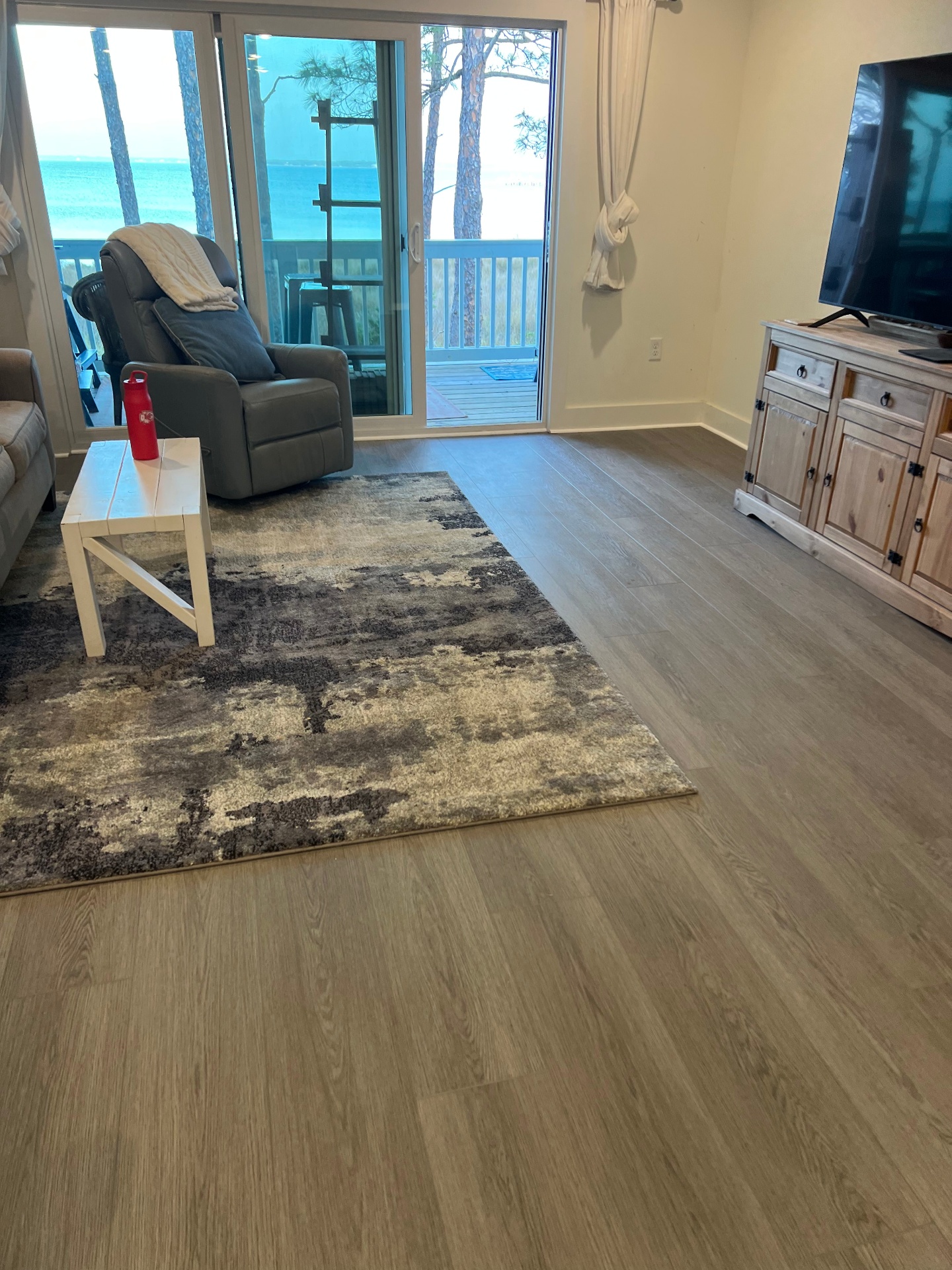
If you have pets, your flooring takes punishment that no product brochure prepares you for. Dog nails clicking and scratching across the surface hundreds of times a day. Cat claws digging into carpet loops. Accidents that soak through to the padding and leave permanent odor no matter how much you clean. Water bowls that get knocked over weekly. Muddy paws tracked in from the Pensacola rain. We've replaced flooring in hundreds of Gulf Coast pet homes — and the homeowners who chose the right material the first time are the ones who aren't calling us back two years later. Here's what actualy works with pets.
What Pets Actually Do to Flooring
Let's be honest about the damage before we talk about solutions. Pet owners tend to underestimate how much stress animals put on flooring.
Scratching. Dog nails — especially large breeds — create micro-scratches with every step. Over months, these accumulate into visible wear patterns on softer materials. Hardwood shows it worst. LVP with a thin wear layer shows it within a year. Tile is immune. Cat claws are sharper but lighter — they damage carpet loops and soft surfaces but rarely affect hard flooring.
Accidents. This is the big one. Pet urine contains ammonia and uric acid that penetrate porous materials and create permanent stains and odors. On carpet, urine soaks through the fibers, through the padding, and into the subfloor — at which point no amount of cleaning fully removes it. On hardwood, urine darkens the wood and breaks down the finish. On LVP and tile, urine sits on the surface where it's easily wiped up. The material you choose determins whether an accident is a 30-second cleanup or a $500 repair.
Water and drool. Large dogs drool. Water bowls get bumped. Wet paws from backyard rain track moisture across floors constantly. In Pensacola where afternoon thunderstorms are a daily summer occurance, your dog is tracking wet paws through the house regularly.
Shedding and hair. This isn't a damage issue but a maintenance one. Pet hair is visible on dark hard floors and embeds in carpet fibers. The flooring you choose affects how much time you spend cleaning — which for pet owners is a serious quality-of-life factor.
The Best Pet-Friendly Flooring Options
Luxury Vinyl Plank (LVP) — Best Overall for Pet Homes
LVP checks every box for pet owners: 100% waterproof (accidents wipe up completely), scratch-resistant wear layer (20+ mil handles large dog nails), comfortable underfoot (softer than tile for pets who lie on the floor), and easy to clean (sweep and damp mop). SPC rigid core LVP won't dent from running paws or sliding bowls. For Pensacola pet homes, mid-range LVP with a 20-28 mil wear layer is the sweet spot — tough enough for daily pet abuse, affordable enough to not stress about. Cost: $4-8/sq ft installed.
Porcelain Tile — Most Durable for Pet Homes
Nothing scratches porcelain tile. Not dog nails, not cat claws, not dragged furniture, not anything your pets can produce. Tile is also 100% waterproof and completely stain-proof — urine, drool, food, mud all wipe clean without any residue. The downsides for pets: tile is hard (older dogs with joint issues may struggle), cold (pets who lie on the floor in winter won't love it), and slippery when wet (textured finishes help). Cost: $5-12/sq ft installed.
Pet-Friendly Carpet — For Bedrooms Only
We know — carpet and pets seems like a terrible combination. And for most carpet, it is. But modern pet-specific carpet with solution-dyed nylon fibers and moisture barrier backing actually handles pet life reasonably well. The solution-dyed fiber means the color goes through the entire strand, so pet urine and cleaning chemicals can't bleach it. Moisture barrier backing prevents liquids from soaking through to the padding. We only recommend carpet with pets in bedrooms — never living rooms, hallways, or anywhere with heavy pet traffic.
What to Avoid with Pets
Solid hardwood — beautiful but dog nails create visible scratches within months, and accidents darken the wood permanently. Standard laminate — not waterproof, destroyed by pet accidents. Regular carpet without moisture barrier — urine soaks to the subfloor and creates permanent odor. Berber/loop carpet with cats — claws pull individual loops, unraveling the carpet.
Why LVP Is the #1 Choice for Pensacola Pet Homes
About 80% of our pet-owning customers in the Pensacola area choose LVP — and there are specific reasons beyond the obvious waterproof benefit.
Wear layer thickness is the key spec. The wear layer is the clear top coating that protects against scratches. For homes without pets, 12 mil is adequate. For homes with cats only, 15-20 mil works. For homes with dogs — especially breeds over 40 lbs — we recommened minimum 20 mil wear layer, and 28 mil for large breed households. Every step up in wear layer adds scratch resistance. A 28 mil LVP will handle a 100-pound Labrador's nails for 20+ years without visible scratching.
SPC core handles pet bowls and accidents. The rigid stone polymer composite core doesn't absorb moisture even if water sits on seams for extended periods. WPC core is softer (more comfortable for pets lying on the floor) but slightly less moisture-resistant at the seams. For serious pet homes, SPC is the safer choice.
Easy cleanup matters more than you think. Pet owners sweep and mop more often than non-pet households. LVP's smooth surface means hair, dander, and dirt don't embed — they sit on top where a quick sweep collects them. Compare that to carpet where you need a HEPA vacuum to extract embedded pet hair, or hardwood where hair collects in grain and between-board gaps.
Replacement is affordable if needed. If a section of LVP does get damaged (a determined chewer, a dragged crate), individual planks can be replaced without redoing the entire floor. Try that with tile or hardwood.
Pet-Friendly Flooring Room by Room
Main living areas (living room, family room, den): LVP is the clear winner. This is where pets spend most of their time — lying on the floor, playing, running to the door, bringing in muddy paws. LVP handles all of it without showing wear. Choose a medium-tone color (not too dark, not too light) to minimize visible pet hair between cleanings.
Kitchen: LVP or porcelain tile. Both handle the water bowl zone, food spills, and constant paw traffic. LVP is more comfortable for dogs who lie on the kitchen floor while you cook. Tile is easier to sanitize around food prep areas.
Bedrooms: This is the one room where pet-friendly carpet can work. Bedrooms see less traffic, fewer accidents (most dogs are trained to go outside), and the comfort benefit of carpet is real for both you and your pets. Choose solution-dyed nylon with moisture barrier backing. Frieze or textured styles hide pet hair between vacuumings better than plush.
Entryway and mudroom: Porcelain tile or LVP. This is the transition zone where wet, muddy paws enter the house. Tile is slightly better because it won't scratch from tracked-in sand and grit. A small entry rug (washable) on top of tile catches the worst of it.
Stairs: Carpet on stairs provides traction for pets — dogs especially struggle on hard-surface stairs and can injure themselves slipping. Pet-friendly carpet on stairs with LVP everywhere else is a common and practical Pensacola setup.
Pet-Friendly Flooring Costs in Pensacola
Here's what pet-optimized flooring costs in the Pensacola market:
LVP with 20+ mil wear layer (pet-grade): $5-8/sq ft installed. The 20 mil minimum for pet homes is about $1/sq ft more than the 12 mil budget option — a small premium for dramatically better scratch resistance.
LVP with 28 mil wear layer (large-dog-grade): $6-9/sq ft installed. Worth the premium for households with German Shepherds, Labs, Golden Retrievers, and other large breeds whose nails create real wear.
Porcelain tile (scratch-proof): $6-12/sq ft installed. Zero scratch risk regardless of pet size. Best for entryways, kitchens, and pet washing areas.
Pet-friendly carpet (solution-dyed + moisture barrier): $3-6/sq ft installed. Brands like Shaw LifeGuard and Mohawk SmartStrand are specifically engineered for pet households.
Whole house pet-friendly renovation (1,200 sq ft LVP + carpet stairs): $7,000-12,000 total. LVP throughout living areas, pet-friendly carpet on stairs only.
See our complete pricing guide or call (850) 903-3703 for a free estimate tailored to your pet household.
Pet Flooring Tips from 25 Years of Gulf Coast Installations
Practical advice we've learned from installing flooring in hundreds of Pensacola pet homes:
Keep nails trimmed. The single most effective thing you can do for your floors — regardless of material — is keep your dog's nails trimmed. Short nails produce dramatically less scratching than long ones. If you can hear clicking on hard floors, the nails are too long.
Place mats under water bowls. Even on waterproof LVP, a silicone mat under the water bowl catches daily splashes and prevents water from sitting in seams. It's a $15 investment that prevents the most common wet spot in any pet home.
Use washable area rugs in heavy-traffic zones. A washable rug at the back door, in the dog's favorite lying spot, and in the hallway where they run catches the worst of the dirt and reduces wear on the underlying floor. Machine-washable rugs from brands like Ruggable are a pet owner's best freind.
Choose the right color. Very dark floors show every pet hair and paw print. Very light floors show every dirt mark. Medium tones — gray, natural oak, warm beige — hide pet evidence between cleanings. This isn't about your color preference — it's about your sanity.
Don't put carpet in the wrong rooms. We've replaced carpet in Pensacola living rooms, hallways, and kitchens where pet owners thought 'modern carpet can handle it.' It can't — not in high-traffic pet zones. Save carpet for bedrooms only. Your nose and your wallet will thank you.
Day Flooring brings pet-friendly samples to your home — see how each option looks and let us assess your specific pet situation. Free consultation, honest advice. Call (850) 903-3703.
Frequently Asked Questions
Porcelain tile is completely scratch-proof — no dog nail can damage it. LVP with 20-28 mil wear layer is the next best option, handling large dog nails for 15-25 years without visible scratching. Hardwood is the worst choice for dogs — it shows nail scratches within months regardless of the finish.
Yes — LVP with a 20+ mil wear layer is our #1 recommendation for large dog households. It's 100% waterproof (handles accidents), scratch-resistant (handles nails), comfortable underfoot (dogs lie on it for hours), and easy to clean (daily pet hair sweeps up in minutes). Choose SPC core for maximum durability.
Only in bedrooms. Modern pet-specific carpet with solution-dyed nylon fibers and moisture barrier backing can handle pet life in low-traffic rooms. Avoid carpet in living rooms, hallways, and kitchens with pets — accidents in high-traffic areas create permanent odor problems. Avoid loop/berber carpet if you have cats — their claws pull the loops.
LVP and porcelain tile are both 100% waterproof — pet accidents sit on the surface and wipe up completely without staining or odor. Carpet absorbs urine into padding and subfloor creating permanent odor. Hardwood darkens and stains from urine. Laminate swells and warps. For pet homes, waterproof flooring is non-negotiable.
Pet-grade LVP (20+ mil wear layer) costs $5-8/sq ft installed in Pensacola. Large-dog-grade LVP (28 mil) runs $6-9/sq ft. Porcelain tile $6-12/sq ft. Pet-friendly carpet $3-6/sq ft. A whole-house pet renovation (1,200 sq ft LVP + carpet stairs) runs $7,000-12,000 total.