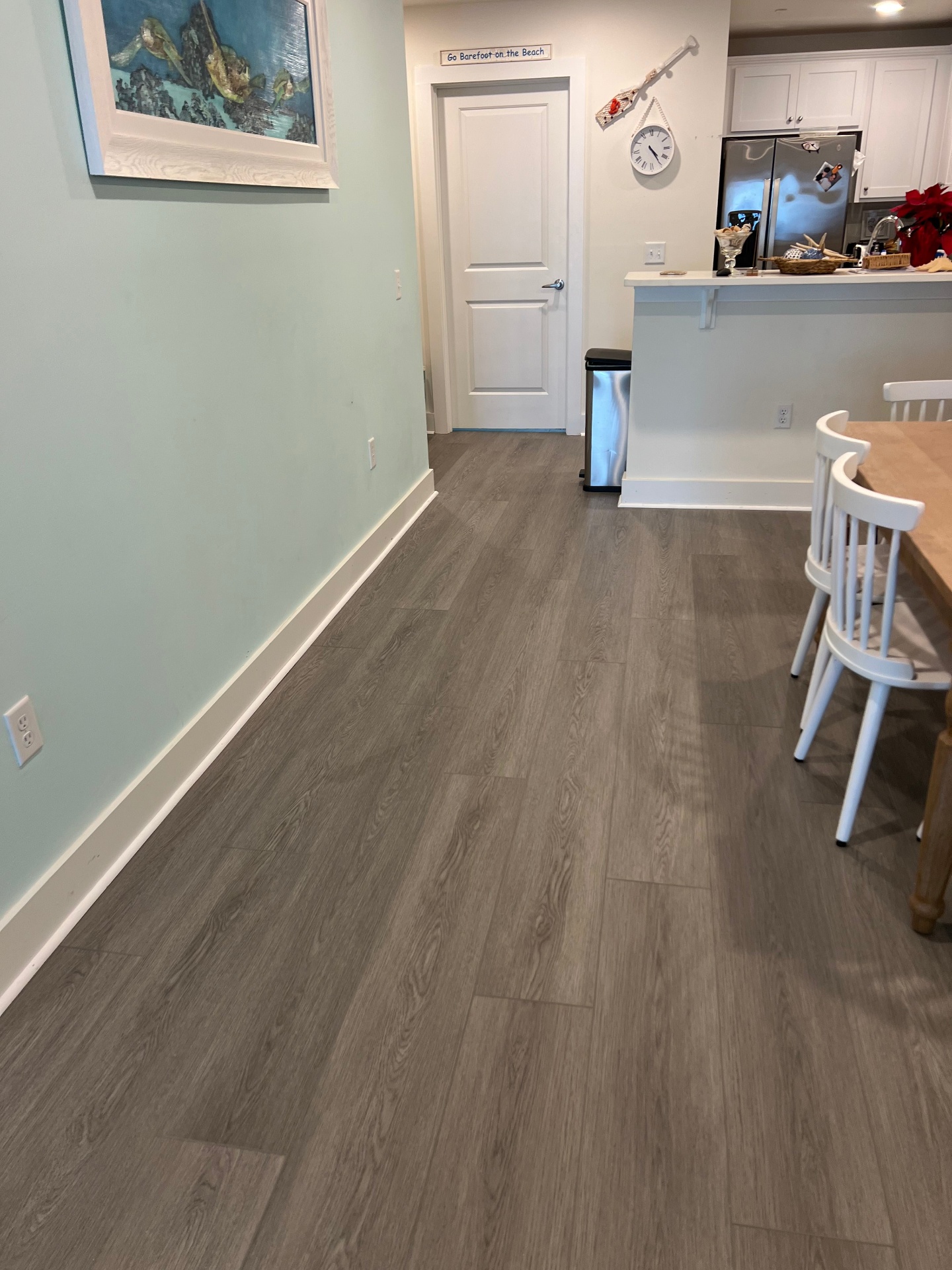
Florida humidity destroys flooring that works perfectly fine in other parts of the country. We've seen solid hardwood cup within months of installation, laminate edges swell until the floor buckles, and carpet develop mold underneath that the homeowner doesn't discover until the whole room smells. Pensacola's climate is beautful to live in but brutal on the wrong flooring materials. After 25+ years of installing floors across the Gulf Coast, we know exactly which products handle our humidity and which ones pretend to. Here's the honest breakdown.
Why Gulf Coast Humidity Is Different from Everywhere Else
When flooring manufacturers test their products for 'moisture resistance,' they're usually testing in conditions that don't come close to what Gulf Coast homes experience.
Outdoor humidity 70-90% year-round. Pensacola's average relative humidity hovers around 75% — significantly higher than national averages. In summer, it regularly exceeds 85%. This isn't occasional dampness — it's a constant moisture load that never lets up.
Indoor humidity is harder to control than you think. Even with air conditioning running, many Pensacola homes sit at 55-65% indoor humidity. Opening a sliding door for five minutes can spike a room's humidity by 10-15%. Homes with older HVAC systems, inadequate insulation, or frequent door traffic can struggle to maintain the 35-55% range that moisture-sensitive flooring requires.
Concrete slabs transmit moisture from below. Most Pensacola homes are built on concrete slab foundations. Florida's high water table pushes moisture vapor up through the concrete — even on slabs that are decades old and appear bone dry on the surface. This upward moisture creates problems for any flooring that traps moisture between itself and the slab.
Temperature swings between indoor and outdoor. Walking from a 95°F garage into a 72°F kitchen creates condensation on surfaces — including flooring. The temperture differential between air-conditioned interiors and Gulf Coast exteriors means flooring materials experience constant thermal cycling that causes expansion and contraction in wood-based products.
Flooring Materials Ranked for Humidity Resistance
Here's how every common flooring type handles Gulf Coast humidity, ranked from best to worst:
1. Porcelain Tile — Immune to humidity. Porcelain absorbs less than 0.5% moisture. Humidity, condensation, flooding — none of it affects porcelain tile at all. Zero expansion, zero contraction, zero degradation from any moisture level. This is the gold standard for Gulf Coast humidity resistance. Cost: $6-12/sq ft installed.
2. Luxury Vinyl Plank (LVP) — Excellent. The vinyl construction doesn't absorb moisture and SPC rigid core doesn't expand or contract from humidity changes. LVP handles Gulf Coast conditions perfectly. The only humidity-related concern is moisture trapped between LVP and a concrete slab — solved with proper vapor barrier underlayment. Cost: $4-8/sq ft installed.
3. Ceramic Tile — Very Good. More porous than porcelain (3-7% absorption) but still handles Gulf Coast humidity well. Seal the surface and grout lines, and ceramic performs reliably in humid conditions. Cost: $5-8/sq ft installed.
4. Engineered Hardwood — Good with precautions. The cross-layered plywood core resists expansion/contraction much better than solid hardwood. Engineered hardwood can work in Gulf Coast homes IF indoor humidity is maintained at 35-55% with consistent HVAC use. Wider planks are more susceptable to movement — 5-inch is safer than 7-inch in our climate. Cost: $6-12/sq ft installed.
5. Water-Resistant Laminate — Marginal. Sealed-edge laminate handles ambient humidity reasonably well but the HDF core remains vulnerable. One spill or humidity spike above 65% for extended periods can cause edge swelling. We only recommend laminate in Gulf Coast homes with excellent climate control and no moisture-prone rooms. Cost: $3-6/sq ft installed.
6. Solid Hardwood — Poor without climate control. Solid wood absorbs and releases moisture with every humidity change. In Pensacola, this means seasonal cupping in summer (edges rise) and gapping in winter (boards shrink). Maintaining 35-55% humidity year-round is essential — which often means running a whole-house dehumidifier. Beautiful product, but high-maintenence in our climate. Cost: $8-15/sq ft installed.
7. Standard Laminate — Poor. The HDF core swells from humidity exposure. Not appropriate for Gulf Coast homes without exceptional climate control.
8. Carpet — Humidity concerns are different. Carpet doesn't warp from humidity, but it can harbor mold and mildew underneath if moisture gets trapped between the carpet backing and the subfloor. In Pensacola, carpet over concrete slabs needs moisture barrier padding. Carpet in well-ventilated bedrooms with HVAC works fine.
Our Top Recommendations for Gulf Coast Homes
Whole-house flooring in Pensacola: LVP throughout. One continuous waterproof surface that handles humidity, spills, pets, and Gulf Coast living without any special maintenance. This is what we install more than any other configuration. Add pet-friendly carpet in bedrooms if you want softness underfoot for sleeping.
Kitchens and bathrooms: Porcelain tile or LVP. Both are completely humidity-proof. Tile for maximum durability, LVP for more comfort. For showers, porcelain tile is the only professional-grade option.
Living rooms in humidity-controlled homes: Engineered hardwood can work beautifully if your HVAC maintains consistent indoor humidity. Wide-plank engineered oak over a concrete slab with glue-down installation is a popular Pensacola choice for homeowners who want real wood and are committed to climate control.
Outdoor living spaces: Outdoor-rated porcelain pavers. Nothing else handles direct sun, rain, salt air, and Gulf Coast humidity simultaneously.
What we tell every Pensacola homeowner: Choose your flooring based on the worst conditions it will face, not the average. Your kitchen floor needs to survive a dishwasher leak. Your entryway needs to handle a hurricane-driven rainstorm blowing through an open door. Your living room needs to perform during the two weeks every summer when you're on vacation and the AC is set to 80°F. If the material can handle those scenarios, daily Gulf Coast humidity won't even register.
How to Protect Any Flooring from Gulf Coast Humidity
Regardless of which flooring you choose, these practices extend its life in our humid climate.
Run your HVAC consistently. The single most important thing you can do. Consistent air conditioning keeps indoor humidity below 60% — the threshold where moisture-sensitive materials start having problems. Don't turn off the AC when you leave for vacation — set it to 78-80°F instead. The humidity spike from a turned-off system can damage hardwood and laminate within days during summer.
Consider a whole-house dehumidifier. If you have hardwood flooring — or plan to install it — a dehumidifier integrated with your HVAC system maintains ideal 35-55% humidity regardless of outdoor conditions. Units cost $1,500-3,000 installed but protect a $10,000+ hardwood investment from humidity damage.
Use vapor barrier underlayment on concrete slabs. Any flooring installed over a Florida concrete slab should have a vapor barrier between the slab and the flooring material. This prevents moisture vapor from the ground from reaching your floors. LVP and laminate use sheet underlayment with built-in vapor barrier. Tile uses modified thinset which acts as a partial barrier. Hardwood uses polyethylene sheeting or a moisture mitigation coating.
Ventilate bathrooms properly. Run bathroom exhaust fans during and for 20 minutes after every shower. Gulf Coast bathrooms without ventilation fans maintain humidity levels that grow mold on any surface — including behind tile if the waterproofing isn't perfect.
Address leaks immediately. In dry climates, a small dishwasher drip might go unnoticed for weeks without causing damage. In Pensacola, that same drip in a 75% humidity environment grows mold within 48 hours. Fix leaks the day you discover them — not next weekend.
What Humidity-Resistant Flooring Costs in Pensacola
Here's what humidity-proof flooring costs in the Gulf Coast market, fully installed:
LVP (best value for humidity resistance): $4-8/sq ft. SPC rigid core handles humidity without any special precautions. The most cost-effective humidity-resistant option for whole-house installations.
Porcelain tile (maximum humidity resistance): $6-12/sq ft. Completely immune to humidity at any level. Worth the premium for bathrooms, kitchens, and outdoor spaces.
Engineered hardwood (humidity-resistant with precautions): $6-12/sq ft + ongoing HVAC maintenance to control indoor humidity. Factor in a $1,500-3,000 dehumidifier if your home doesn't already maintain consistent humidity.
Solid hardwood (humidity-sensitive, needs climate control): $8-15/sq ft + dehumidifier investment. Beautiful but requires ongoing attention to indoor humidity levels.
For comparison: replacing failed flooring after humidity damage costs 100% of the original installation plus demo of the damaged material ($1-3/sq ft). Choosing the right material from the start is dramaticly cheaper than choosing wrong and replacing.
See our complete pricing guide or schedule a free in-home consultation.
Bottom Line — Choosing Flooring for the Gulf Coast
After 25 years and 4,000+ floors across the Gulf Coast, here's what we've learned about humidity and flooring:
The safest choice is always waterproof. LVP and porcelain tile don't care about humidity levels — ever. If you want zero humidity-related maintenance, zero risk of moisture damage, and zero worrying about what happens when the AC goes out during a summer storm, choose waterproof flooring throughout your home.
Engineered hardwood works with commitment. If you love the look and feel of real wood and you're willing to maintain consistent indoor humidity with your HVAC system, engineered hardwood performs well in Gulf Coast homes. Just understand that it requires ongoing climate management — it's not a set-it-and-forget-it material like LVP or tile.
Solid hardwood is beautiful but demanding. We install solid hardwood in Pensacola homes where the homeowner understands and accepts the maintenance requirements. It's a luxury material that rewards careful stewardship with decades of beauty. It punishes neglect with cupping, gapping, and costly repairs.
Avoid standard laminate in Gulf Coast homes. The risk-reward ratio simply doesn't work. For $1-2 more per square foot, LVP gives you a waterproof product that looks nearly identical. There's no scenario where laminate is the right choice for a humidity-prone Florida home.
Day Flooring helps Pensacola homeowners choose climate-appropriate flooring based on 25+ years of Gulf Coast experience. We'll be honest about what works in your specific home, your specific rooms, and your specific lifestyle. Call (850) 903-3703 for your free consultation.
Frequently Asked Questions
LVP (luxury vinyl plank) and porcelain tile are the best flooring options for Florida humidity — both are completely unaffected by moisture levels. Engineered hardwood works with consistent indoor climate control. Solid hardwood and standard laminate are risky in Gulf Coast humidity without careful management.
Yes — LVP is 100% waterproof and does not expand or contract from humidity changes. SPC rigid core LVP is particularly stable in temperature and humidity fluctuations. It's the most popular flooring choice in the Pensacola and Gulf Coast area specifically because it handles our humidity without any issues.
Engineered hardwood works well in Florida homes that maintain consistent indoor humidity (35-55%) with air conditioning and/or a dehumidifier. Solid hardwood is more risky — it cups in high humidity and gaps in low humidity. If you choose hardwood for a Gulf Coast home, engineered is the safer option, and consistent HVAC use is essential.
Standard laminate is not recommended for Pensacola homes. The HDF core is moisture-sensitive and Gulf Coast humidity can cause edge swelling and buckling. Water-resistant laminate with sealed edges handles ambient humidity better but is still vulnerable to spills and leaks. For $1-2 more per square foot, LVP provides genuine waterproof performance.
Run your HVAC consistently (never turn it off, even on vacation — set to 78-80°F minimum). Consider a whole-house dehumidifier ($1,500-3,000 installed) to maintain 35-55% indoor humidity. Use vapor barrier under hardwood over concrete slabs. Choose engineered over solid for better dimensional stability. Keep doors closed to minimize humidity intrusion from outdoors.